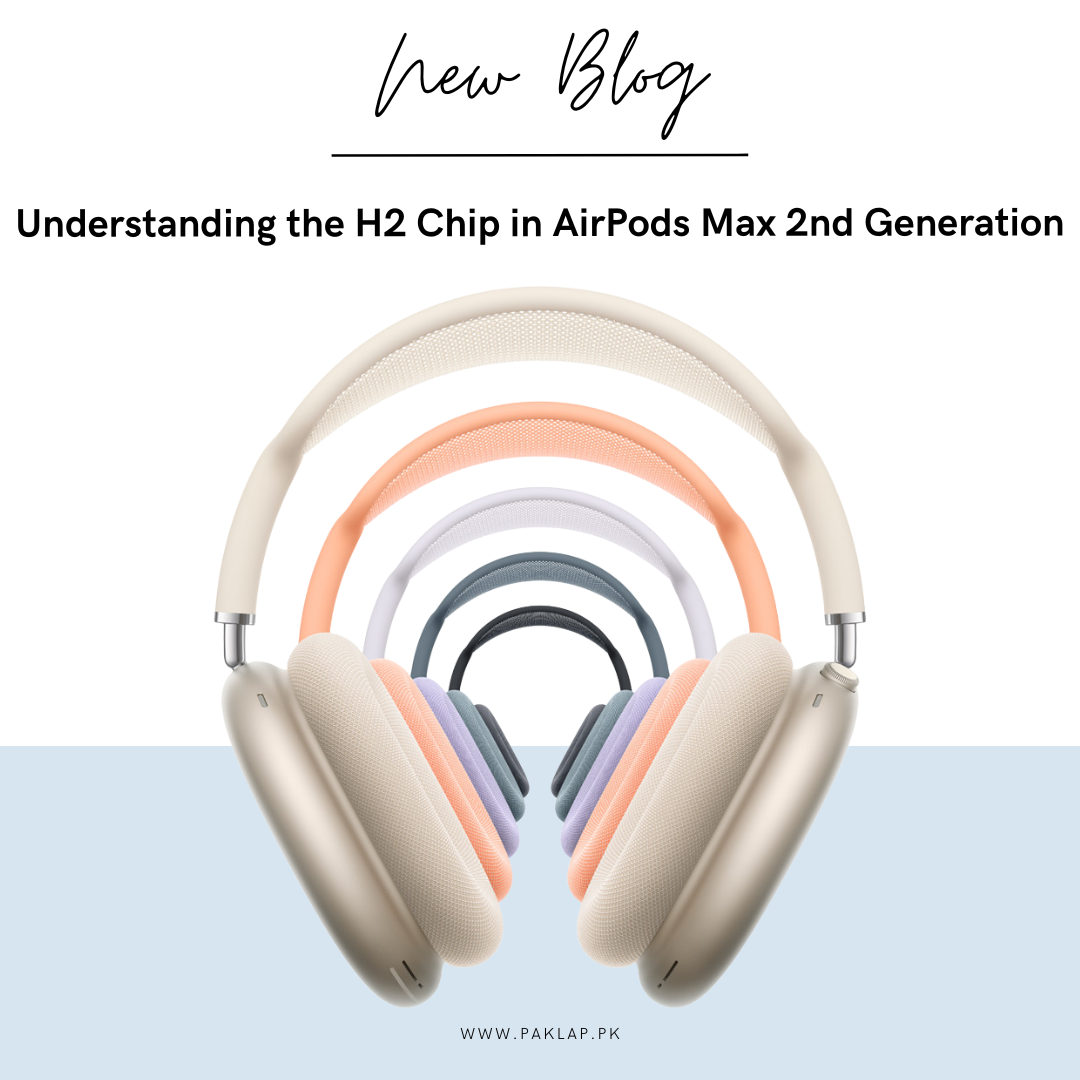
If you ever feel irrelevant, just remember that Apple launched the Airpods Max 1st Gen only to replace it with the 2nd Gen. And while professionals claim that this isn’t a “replacement”, with both versions having their attributes, we know better.
There are countless rumors attached to the Airpods Max 2. Rumored to be released in the fourth quarter of 2024, and not out yet, these headsets have created intense anticipation among crowds. They are also said to be one of the finest releases of Apple to date, and we can vouch for that! Why, you ask? Because these bad boys feature the iconic H2 Headphone Chip.
It’s because of the H2 processor that the Airpods Pro 2 became the best-ever Airpods in the history of the company. Now that it’s obvious that the H2 chip is GOAT, it’s time to get into the technicalities. What more do you get from the Airpods Max 2 with its H2 processor? Head below to know.
What is the H2 Chip in Apple AirPods?
As a product of the Apple Silicone, the H2 chip (which is second in line with the H series) is well hyped-up. The processor itself was released in September 2022 and has since been the crowned jewel of AirPods Pro 2, 4, and 4 ANC. Previous models of the earbuds and even Airpods Max 1 featured either the W1 or the H1 processor. In comparison, the H2 outranks both W1 and H1 with its uncompressed sound.
The main goal of this processor is to enable a smooth Bluetooth streaming experience, and true to its role, it does that. With Bluetooth 5.3, this device delivers audio through extended range, and that too without interference. Avoiding congested channels, the processor makes these headsets truly wireless allowing you to enjoy crisp and clear words or music.
Features of Airpods Max 2 Supported by H2 Chip
Superior Noise Cancellation
It’s extremely tough to achieve 100% noise cancellation in earbuds due to the open design which doesn’t cover the ear cavity completely. Yet the H2 chip did its magic and made Pods Pro 2 as sealed as possible, leading to them being the ultimate Apple earpods. That was until the announcement of the Pods Max 2nd-Gen.
With the caliber of the H2, it is understood that this product will be ten times better at noise cancellation than the Pro 2. In active noise cancellation, the unwanted roar is canceled through generated artificial sound waves. As per the usual drill, incoming clatter from the environment is caught by a microphone. The artificial sound waves are then transmitted along the same route as the unwanted waves (not coming from the opposite directions), canceling the primary source.
Advanced 3D Audio Effects
Spatial audio is a major phenomenon in headphones, brought forward to add a touch of realism to your ears. It aims to deliver audio mixed with enough din to make you feel physically present in a situation, whether you’re on call or playing a game. The incoming sound starts as a 1-dimensional wave but reaches your ears from three dimensions.
As simple as it seems, this conversion of plain waves into 3D (full of effects) is super complicated. The H2 processor starts by filtering the entering clatter. It is then recorded with head-related impulse responses and then sent to you. This way the sound reflects the walls of your ear canal and divides like laser beams by the time it reaches your cochlea.
Enhanced Sound Quality
The main difference between noise cancellation and voice isolation is that one cuts down the unwelcome babble, while the other simply blocks it from entering. The good part about the H2 chip in these new headphones is that they offer voice isolation, making the tonality even better.
Even though most headphones are understood to have voice isolation, the Max 2 aims towards passive noise cancelation (PNC), which is an advanced version of basic voice isolation.
At first step the full coverage of the headset cocoons your ears and the area around, blocking most of the racket outside. Then the processing card utilizes AI to reduce the babble by keeping the frequency to a minimum. Due to this intervention of machine learning, only your primary conversation is delivered with ultimate clarity.
Durable Battery Life
One of the prominent functions of the H2 card is said to be its battery support, as proven in Pro 2. The previous models feature a listening duration of 20 hours, and being charged fully within an hour or so. The H2 chip, on the other hand, delivers up to 30 hours of listening time despite running overtime with the added tonality effects.
This feature is ideal for the battery health of the device as well since it negates the constant charging of the battery. The more you expose your battery to heat and energy (by overcharging), the more its health diminishes. So this H2 processor is a life-saver for people who rely on headphones for most of their day.
Wireless Audio Latency
As you know, the Max 2 are wireless, and most wireless ear devices face the problem of slow signals. This situation is called low latency when the music leaves the primary source but doesn’t reach you. As seen with the Pro 2, it is evident that the processing card boosts pairing speed and supports audio latency.
With Bluetooth 5.3, your headgear gets connected to the device in a matter of milliseconds, which is up to a distance of up to 240 meters. This saves you from the triggering wait and guarantees a buffer-free listening experience.
Conclusion
There, the secret to headsets that could leave your ears numb from their durable battery and audible sound. The H2 chip is undoubtedly a genius invention by Apple, one that fairly deserves all the praise in the world.
It won’t be wrong to quote this headphone processor as one of a kind, considering no other brand has been able to achieve this level of clarity without disturbing the aesthetics. So that’s our take on the controversial Airpods Max 2 equipped with H2 chip.