
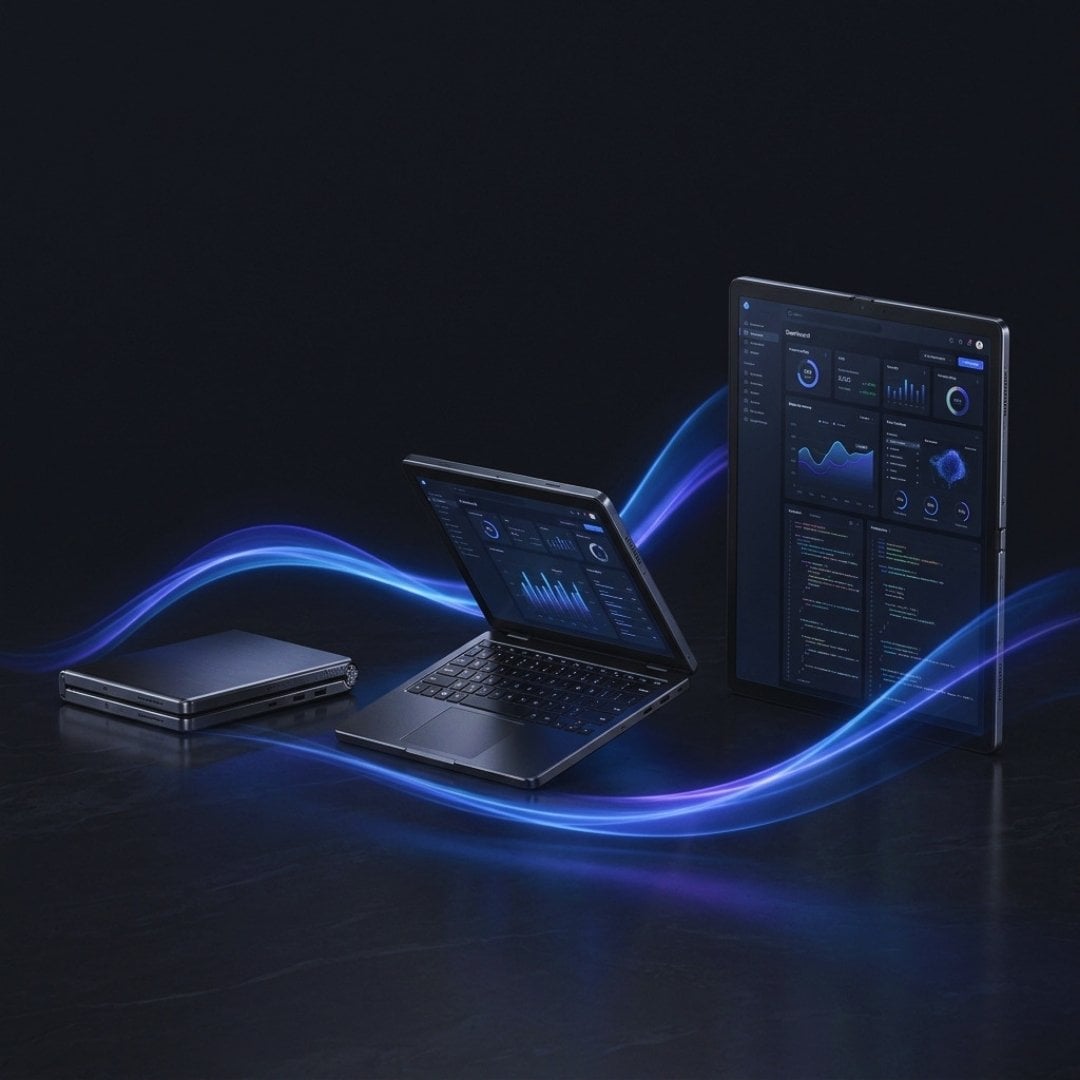
Foldable laptops are no longer sci-fi fantasy, but your everyday reality. They are turning heads, making headlines, and leaving traditional notebooks looking basic. Seriously, who wouldn’t want a screen that doubles as a tablet? It’s so futuristic and cool, isn’t it?
However, like every seemingly aesthetic thing, this flashy hardware comes with baggage. Now, the technology is real, but reviews are pretty mixed. So the question is - are foldables really the next big thing? Or do the cons outweigh the pros?
In this blog, we’ll break down all the benefits and drawbacks of foldables to figure out if they’re actually a keeper or not. So stick with us till the end, because it’s going to get a lot more interesting.
Why Foldable Laptops Could Be Revolutionary?
Before deciding whether folding notebooks are worth the hype or not, it’s better to check out their major benefits. Below, we’ve mentioned what makes the foldable technology exciting.
Larger Screen Real Estate
Not long ago, when getting a laptop, you had to choose between portability and a big screen size because getting one meant saying goodbye to the other. Most mainstream notebooks have big screens like 13-inch, 14-inch, and 16-inch (sometimes even 17-inch). And usually, the larger the screen, the heavier the device.
To solve this issue, foldables came. Take the Lenovo ThinkPad X1 Fold, for example. It’s a 0.9kg notebook with a 13.3-inch wide display. When you unfold it, the max space it’ll need is 13.61 inches, but when folded, it literally shrinks to 0.68 inches. So you don’t really have to give up portability for a bigger screen anymore.
Better For Multitasking
For those arguing on maximalism overkill, and ‘no need for big screens’, here’s the thing - more screen space means less screen stress. On a small display, you’ll have to work on two different windows to multitask. Even then, your screen would feel suffocatingly cramped sometimes. Not to forget how hard it gets on your eyes.
But with these notebooks, you can comfortably work side by side on different things without needing to resize the windows. Plus, you don’t have to switch between apps and tabs as much. This kind of explains why large screens improve users’ performance by 200% to 300%. This is why students and professionals usually prefer 17-inch notebooks.
Hybrid Device Potential
The most interesting part about them is that they’re not restricted to a single role. Like, a traditional laptop can only be used in one way, and that’s it. The same goes for a regular tablet. But a folding notebook can be both (laptop and tablet), and sometimes more (tent mode), based on your needs.
Foldables literally give you multiple gadgets at the price of one. Now, if we ask everyone, “What will they choose for their personal use?” 30% of the population will be siding with laptops and 26% siding with tablets, and the rest would opt for both. That’s when a foldable notebook comes in handy. It literally gives you the best of both worlds.
Improved Technology
The first few batches of these gadgets were pretty cool in theory, but in practice, there were a few things off. For starters, there were display creases, limited brightness, poor visual quality, and some serious reliability concerns. It debuted as that kind of tech which looks good from afar, but in reality, was a waste of money.
However, now the folding technology has changed a lot. Like the folding devices today, use ultra-thin glass which is not just durable but minimizes the surface crease. It’s already known for the enhanced display quality, but when you go tablet mode, this glass will make it easy for the stylus to glide on top of it. Also, the hinge mechanisms are way better now with smoother folding.
AI-Powered Foldables
The AI revolution isn’t just related to software; it also needs hardware that can keep up. And AI takes the foldable experience to a whole new level. You see, the large displays of folding devices give AI tools and software enough room to function. So, no more bouncing between windows every other minute.
Your AI task stay open on the side while you work on your main task. So yeah, as long as the device has a dedicated neural engine and cloud services, your foldable notebook will let you avail the full AI experience. Your overall computing session will just feel fluid and better than any regular session.
The Downsides of Folding Laptop Technology
Every innovation comes with its fair share of challenges, and this particular technology is no exception. Head below to know the main concerns of critics.
Bad Battery Life
Most foldables have poor battery life because the thin chassis doesn’t have enough space to accommodate big battery cells. And all the energy from those small cells gets wasted majorly on the large displays (especially at high brightness).
Plus, foldables have extra components like hinge sensors, display orientation sensors, and stylus support, which together increase the overall power drain.
Durability Issues
Display fatigue, creases, pixel damage; there’s too much going on with the flexible display of foldables. The hinges are the weakest spots, though; they can get loose and wobbly (sometimes even stiff) with just a little bit of carelessness.
Also, dust and debris can easily get trapped in the hinges, affecting movement. The worst part is that the repair of these parts is not just time-consuming but also very expensive.
Price Factor
Foldables are jam-packed with the most premium material - magnesium-alloy frames, carbon-fibre reinforcements, protective display coatings, and so on. They also normally feature hefty, expensive OLED displays.
The most important part is that these notebooks aren’t manufactured in bulk; they’re still a niche product with limited demand. This is why foldable notebooks cost thousands of bucks even for the most entry-level ones.
Software Gaps
On these laptops, your screen can change sizes, but the stretch can be pretty awkward. This switch between tablet mode and laptop mode isn’t smooth most of the time. Similarly, some software doesn’t respond to the screen change easily.
For example, sometimes a video may pause or resize unexpectedly, or apps may behave unpredictably. Though these software issues are pretty rare, it does happen.
Final Word
The hype behind foldable laptops is real, but it’s also justified! Come to think of it, the future should be full of portable gadgets, things that don’t burden you much. And foldables are the perfect innovation. Yes, they’re expensive, and there are some durability concerns. But the pros are definitely bigger.
You get a larger workspace with better multitasking potential and a tech form that suits the AI era. So yeah, foldables definitely deserve a place in the market. If we deal with the durability issue, they are 100% a futuristic gadget that’s loaded with potential.