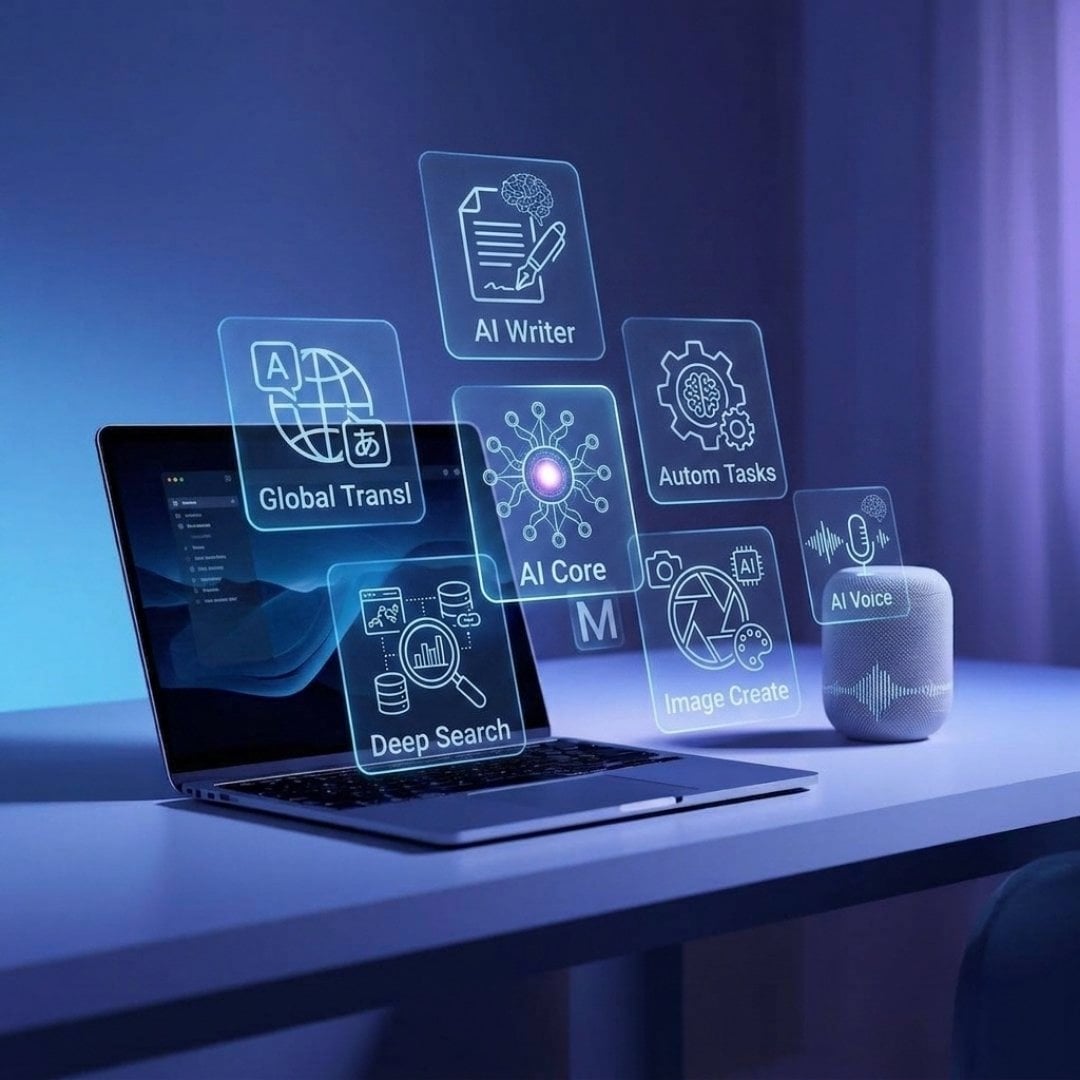
There’s a quiet buzz in the industry right now. Nothing loud or official. Just some rumours saying that AI is going to change the ways of traditional computing.
Now, it’s no secret that AI is taking over everything. Every tool you use, every software you run, even entire digital infrastructures and ecosystems, features AI. Makes one wonder what the future holds for us. Like, seriously, is artificial intelligence going to change your regular computing experience for the better? Or will there be consequences?
In this blog, we’ll answer all those questions and more. So stick around to get a closer look at what’s happening behind the scenes.
The Present Shift From Traditional Computing to AI Everyday Computing
Your computing habits will change in the long run, that’s for sure. However, this change won’t be dramatic, but more of a slow burn. Head below to know more.
Passive Intelligence
Normally, using a notebook means that you have to be very hands-on with the device. Every click, every search, every step has to be spelt out to the machine. It's like handing out commands to an employee. But with AI, things are different!
Instead of waiting for explicit commands, modern artificial intelligence tools deliver what you need. They do this by analysing your past behaviour and predicting your intent. At first, it will be like a trial-and-error process, but as you go, the tools will understand patterns better.
And before you know it, your device will be making decisions on your behalf. We know it sounds kind of creepy, but it’ll actually give you a major productivity edge. Your workflows will be faster, and your overall experience will feel super smooth. Not to mention, this passive intelligence will make your routine tasks automated in no time.
Cloud Over Hardware
Cloud reliance in 2026 is real, you guys! Globally, 94% of companies are using cloud computing to store around 60% of their business data. These stats tell you a lot about where we’re heading. Even today, when someone wants to buy a notebook, their very first concern is hardware specs (like RAM and SSD).
But a few years from now, the main concern will be cloud capacity. You see, AI is being designed so that it transfers the major bulk of the workload of your device to the cloud. So, your device will become sort of a vessel or a remote control. All the real substance will be on remote servers.
So yeah, future-you is going to be heavily dependent on the cloud server. That said, you also won’t have to upgrade your hardware much. This is because cloud-based tools upgrade without needing any hardware changes.
Speak To Compute
The only means of interaction between you and your computer was the keyboard. You typed and entered the command, and your system obeyed. But AI changed this. Now, you don’t have to type everything anymore. Just say it out loud, and the system will get it (just like Alexa and Siri).
This voice assistant technology is already pretty popular. Globally, 20.5% of people use voice searches because it just makes their life easier. Now imagine if you could deliver whole commands and instructions without having to even click a key. The AI-powered Automatic Speech Recognition (ASR) will convert your voice into readable text.
Sounds futuristic, doesn’t it? This shift will make laptops even more accessible than they are now. Elderly people, non-native language speakers, and individuals with any kind of disability that prevents them from using the keyboard will be able to use the device normally.
AI Takes Charge
Using a notebook might sometimes feel exhausting. Like, what do you mean you have to go through three to four steps just to send an email? Click here, open that, switch tabs - takes too much time and effort, honestly. But with AI, you don’t have to navigate through all these steps.
Now you just have to ask your system to do the command, and it will do it. For example, if you have to read 100 emails but don’t have enough time, no worries. The built-in AI in your system will summarise all of those emails and present them to you in a concise, compiled form.
Similarly, if you want to offload a more judgement-based task, say, booking a flight with an airline, AI could do that as well. Though instead of proceeding on its own, it will provide you with comparisons and wait for your approval. So while AI is not going to be 100% independent, it will manage a lot of your work.
What Does This Mean for the Future of Personal Computing?
Your notebook isn’t going anywhere; it will get a glow-up, though. Below we’ve mentioned a few changes that you’ll notice in the notebooks of tomorrow.
Laptop Design 2.0
The classic clamshell notebook design? Yeah, that’s definitely changing! Dual-screen convertibles and detachable keyboards are the new in.
With AI-powered Automatic Speech Recognition (ASR) and predictive text handling draft generation, the way we interact with laptops is evolving. This doesn’t mean physical keyboards are vanishing – they are, instead, becoming modular and tactile. Plus, the newer designs are introducing wireless, magnetic and detachable keyboards.
Always-On AI
Ambient computing is the next big thing! It's when AI is there on your device at all times, whether WiFi is on or not. It's quietly doing its thing in the background - watching patterns, organising data, preparing for any likely commands. In short, the AI will become part of the system, working alongside you.
Interaction Pattern Shift
Your reliance on artificial intelligence tools will increase in the future. You can see it even today. Students are using AI to generate drafts first before typing anything from scratch. Professionals are letting these tools take over with all the scheduling, summarising, and research work. With time, users’ manual input while computing will reduce even more.
Smaller Smarter Devices
Remember when computers used to be literal room-sized machines? Technology has a way of shrinking hardware, we can say. With dedicated NPUs, AI performs the tasks of a lot of conventional components in your current notebook. For example, the need for RAM, SSD, and dGPUs (because of creative tools) won’t be as heavy as it is now.
Final Word
So, is AI changing traditional laptop usage? To an extent, yes! Even today, with the little AI exposure we have, it has changed the way of computing dramatically. Just imagine if AI completely takes over; the things that could happen (in all good sense, of course). You won’t have to click endlessly or follow tiringly long steps to perform basic functions.
As a result, your notebooks will become slimmer, sleeker, and hopefully more good-looking. Also, you won’t have to pay for extra-high RAM and SSD GBs. Initially, people thought there were more drawbacks, but if we look at the bigger picture, the pros seem to dominate. So, at the end of the day, it’s like a win-win situation for the future-you!