
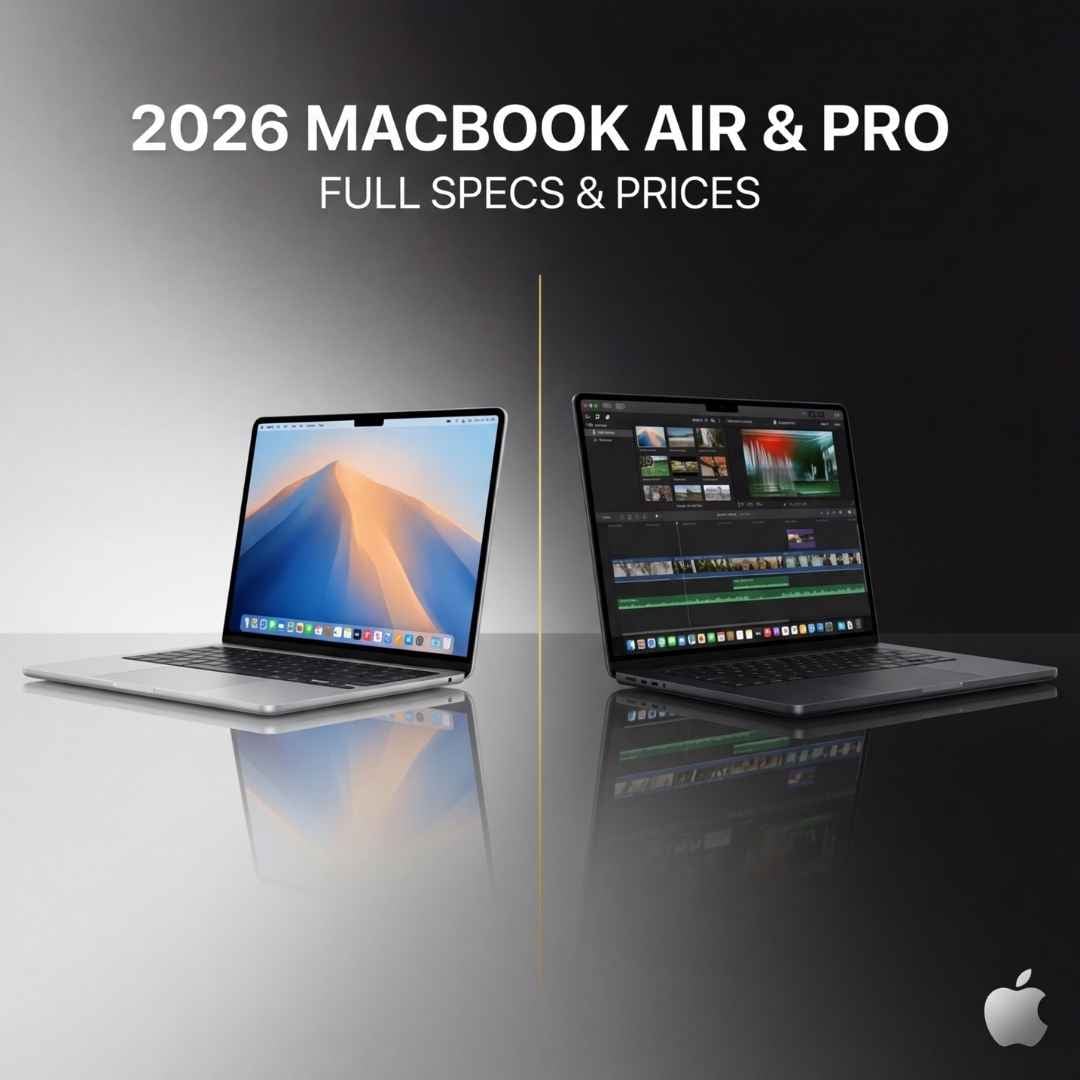
MacBook is back with a bang, and honestly… it seems ready with all its big guns. Tech-enthusiasts, business professionals, and creative audiences have already been eyeing the 2026 MacBook Air and Pro models. It happens every year, so it’s pretty much a drill now.
However, it’s not every year that Apple satisfies its loyal customers with something new. Sometimes the reimagined innovation is just an unnecessary addition that doesn’t make much of a difference. So what is it going to be this year? Yay? Or Nay?
Guess you’ll have to find out by weighing the specifications against the price tag. In this blog, we’ve broken down everything (literally every spec) about both the models of 2026. Good luck deciding if Apple’s done the job right this time.
MacBook Air and Pro 2026 - Short Intro
The MacBook Air has always been Apple’s prized possession. It’s loved by everyday users and professionals who need a lightweight and super-fast gadget that’s equally capable of surviving the corporate madness. The 2026 edition is different, however. It comes in two sizes of 13.6 and 15.3 inches. The star of the show in this edition is the M5 chip, which basically powers the CPU and GPU (as well as the AI processor). These two models are available in the colors sky blue, midnight, starlight, and silver; the rest of the design is almost the same as the last release.
With the MacBook Pro, Apple targets the workaholics and creative professionals, always! This entire line is developed in a way to handle intense, demanding workloads without having any burnout. The 2026 Pro edition is also the same - sturdy from the inside, but soft from the outside. This new edition is available in two sizes: 14 and 16 inches. But the main variety comes with its processors. You can find both sizes with three chip options of M5, M5 Pro, and M5 Max. The numbers keep increasing as you go from M5 to M5 Max naturally, but one thing remains constant - the Space Black and Silver finish.
2026 MacBook Air - Full Specs & Price Breakdown
The 13 and 15-inch MacBook Air models of 2026 are powered by the M5 chip. Below, we’ve mentioned all the specs and prices of these laptops.
MacBook Air 13 and 15-inch (M5)
Specs | Details |
Processor Chip | Apple M5 (10-core processor, up to 10-core graphics, 16-core Neural Engine) |
Display (13”) | 13.6” Liquid Retina, 2560x1664 resolution, 224 ppi |
Display (15”) | 15.3” Liquid Retina, 2880x1864resolution, 224 ppi |
Unified Memory | 16 GB (configurable up to 24 GB and 32 GB) |
Storage | 512 GB SSD (configurable up to 4 TB) |
Battery Life | Up to 18 hours |
Ports | 2x Thunderbolt 4, MagSafe 3, 3.5mm headphone jack |
Wireless Connectivity | WiFi 7, Bluetooth 6 (via N1 Chip) |
Camera | 12 MP Center Stage camera with Desk View Support |
Audio (13”) | 4 Speaker system with Spatial Audio & Dolby Atmos support |
Audio (15”) | 6 Speaker system with Spatial Audio & Dolby Atmos support |
External Displays | Up to 2 external displays |
Operating System | MacOS Tahoe |
Starting Price (13”, 512 GB) | $1099 |
Starting Price (15”, 512 GB) | $1299 |
2026 MacBook Pro - Full Specs & Price Breakdown
The MacBook Pro models of 2026 bring in a crazy variety from all ends. The standard M5 has almost the same specs as the Air variant, which makes Pro and Max all the more desirable. Sure, the M5 version costs way less (starting at around $1699 and $2699 for the 14 and 16-inch versions, respectively), but the performance difference is pretty evident.
Head below to check out the different specs and prices of the 14 and 16-inch models run by M5, M5 Pro, and M5 Max.
MacBook Pro 14 & 16-inch (M5 Pro)
Specs | Details |
Processor Chip | Apple M5 Pro (18-core processor, 20-core graphics, 16-core Neural Engine) |
Display (14”) | 14.2” Liquid Retina XDR, 3024x1964 resolution, 254 ppi |
Display (16”) | 16.2” Liquid Retina XDR, 3456x2234resolution, 254 ppi |
Unified Memory | 24GB (configurable up to 64 GB) |
Storage | 1 TB SSD (configurable up to 8 TB) |
Battery Life | Up to 24 hours |
Ports | MagSafe 3, 3x Thunderbolt 5, HDMI 2.1, SDXC Card Slot |
Wireless Connectivity | WiFi 7, Bluetooth 6 (via N1 Chip) |
Camera | 12 MP Center Stage Camera |
Audio | 6 Speaker System with Spatial Audio & Dolby Atmos Support |
External Displays | Up to 3 external displays |
Operating System | MacOS Tahoe |
Starting Price (14”, M5 Pro, 1TB) | $2199 |
Starting Price (16”, M5 Pro, 1TB) | $2699 |
MacBook Pro 14 & 16-inch (M5 Max)
Specs | Details |
Processor Chip | Apple M5 Max (18-core processor, 40-core graphics, 16-core Neural Engine) |
Display (14”) | 14.2” Liquid Retina XDR, 3024x1964 resolution, 254 ppi |
Display (16”) | 16.2” Liquid Retina XDR, 3456x2234resolution, 254 ppi |
Unified Memory | 36 GB (configurable up to 128 GB) |
Storage | 2 TB SSD (configurable up to 8 TB) |
Battery Life | Up to 24 hours |
Ports | 3x Thunderbolt 5, HDMI 2.1, SDXC Card Slot, magSafe 3 |
Wireless Connectivity | WiFi 7, Bluetooth 6 (via N1 Chip) |
Camera | 12 MP Center Stage Camera |
Audio | 6 Speaker System with Spatial Audio & Dolby Atmos Support |
External Displays | Up to 4 external displays |
Operating System | macOS Tahoe |
Starting Price (14”, M5 Max, 2 TB) | $3599 |
Starting Price (16”, M5 Max, 2 TB) | $3899 |
Everything That’s New in 2026 MacBook Air & Pro Models
Doesn’t matter if you’re looking at the 2026 models on their own or comparing them with last year’s M4 models; you’re simply bound to be impressed.
The M5 Chip (Standard, Pro, & Max)
The best part about the M5 chip is its Super cores. It's quite a new concept, as previously there were Performance and Efficiency cores. A Super Core is like the best-performing core in the M5 CPU architecture. Where the P-cores are like the fast-acting ones, and the E-cores are the power-saving ones, Super Cores outshine both. This is why the M5 chip has 4 Super cores, the M5 Pro has 5 and 6 Super cores, while the M5 Max chip features 6 Super Cores in combination with either P or E cores.
2x Base Storage & 2x Faster SSD
Nobody wants to keep upgrading their storage, which is why Apple has made sure the 2026 Mac Air and Pro models have double the base storage and twice the base SSD capacity compared to the last release. So the Air models start at 512 GB, whereas the Pro and Max start at 1 TB and 2 TB, respectively. Plus, these new SSDs have better read and write speeds, which just makes life easier for anyone working with large files.
The Apple N1 Chip
The 2026 Mac Air and Pro are the first in the history of the company to have WiFi 7 and Bluetooth 6 - all courtesy of the N1 Chip. It’s the second highlight (to the M5 Chip) of the year, which makes sure that you face zero connectivity issues whatsoever. The WiFi 7 is literally a Godsend for those working in wireless settings, where video calls, gaming, and using the internet become impossible. Similarly, Bluetooth 6 can come in handy when you’re switching between Apple devices or trying to connect to them within a snap.
AI Integration via macOS Tahoe
MacOS Tahoe is Apple’s most Intelligent Operating System yet - there, we said it!
What we love the most about Tahoe is that it is literally built around Apple Intelligence. The M5 chip’s 16-core Neural Engine handles all kinds of AI tasks locally on the MacBook, so your data never truly leaves the device. Your prompts, your documents, your conversation, and everything stay protected without a steady internet connection as a sort of prerequisite. Yet, our favourite part remains the ChatGPT integration across writing tools and Siri (which, by the way, is going to be better at solving your queries rather than fiddling and faddling).
Conclusion
After looking at all those specs, one thing’s for sure - Apple didn’t play it safe at all! The M5 chip is the real deal. It’s got the P-cores, the E-cores, and the all-new Super cores. The storage is also finally just the number that it should’ve been long ago. And with WiFi 7 and Bluetooth 6 - these new laptops have become unstoppable (till Apple’s next big launch at least).
So, is it cheap? Absolutely not! The starting price tag of $1099 for Mac Air and $1699 for Mac Pro is insane. As for the Mac M5 Pro and M5 Max costing $2199+ and $3599+ is also a horrendous pricing strategy, but luxury never comes cheaply.