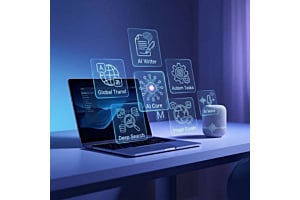

Artificial intelligence has finally departed from smartphones and cloud platforms to our laptops. Billed and branded as "AI laptops," they come with special AI processors, or NPUs. These fancy terms basically deal with high-tech tasks like real-time translation and smart video processing.
The aim of AI is clear: smarter performance and a hassle-free computing experience. But how much of that tech is genuinely useful and how much is spin camouflaged as innovation? While some of these newfangled features already beef up productivity, others are wishful thinking rather than necessary.
In this blog, we’ll cut through the hype to show you what truly works and what does not. So stick around till the end, because we're about to uncover the true worth of AI laptops.
What is an AI Laptop?
An AI laptop is a sort of a new generation of computer that is designed to carry out the technical, heavy-computational tasks of artificial intelligence. So, instead of depending exclusively on cloud services, your one-stop for all kinds of data is your laptop. Central to all such AI-related machines is a special CPU known as an NPU (Neural Processing Unit).
NPUs are specifically designed to work on AI-based workloads and so are distinct from regular CPUs and GPUs. These chips enable tasks like real-time transcription, face identification, and even controlling of powers, which sounds insane, but is true. That empowers AI PCs to access tasks in a better manner in some regards, even reducing power usage.
The best part of these new-gen computers is that they don't compromise on your privacy whatsoever. This is because sensitive AI tasks are processed locally without uploading anything online. An AI laptop is essentially a regular laptop that is infused with smart specs to make daily tasks faster, smarter, and more automatic. However, no matter how good all this actually is, it all depends on how well the software takes advantage of the tech itself.
Understanding Components of an AI Laptop
An AI laptop is one that integrates processors, graphics, memory, storage, and power management using AI to provide faster and more intelligent performance.
Central Processing Unit
The CPU is still the brain of any laptop, but on AI notebooks, it functions differently. Rather than bearing all of the performance load, it teams up with GPUs and NPUs to distribute tasks in a smarter way. Thanks to this new concept of teamwork, daily functions become straightforward and simply snappier.
AI-based scheduling enables the CPU to juggle critical tasks while shedding less important or power-intensive tasks to special-purpose chips. This results in less slowdown compared to a traditional laptop, improved thermal effectiveness, and a healthier load. To the user, it means faster performance without feeling that the laptop is struggling. This especially becomes prominent when you're taking a break from creative work and transitioning into casual everyday usage.
Graphics Processing Unit
The GPU plays a major role in AI PCs, especially when it comes to visuals, design, or gaming. Traditional GPUs are concerned only with rendering graphics and boosting creative work processes. In AI notebooks, however, GPUs also incorporate AI acceleration functions and manage work such as smart upscaling when editing videos. Not to forget, it also assists in improving game graphics in real time, or enhancing video call quality through blur and noise elimination.
This dual function is what makes AI notebooks distinctive, as GPUs no longer only render pixels but actually improve user experiences through AI. When compared to a non-AI laptop, you'll experience faster creative work processes, along with higher-quality graphics with no added pressure on the CPU. For a gamer or designer, the GPU in an AI laptop provides an overall smooth-flowing, visually stunning, and smart experience.
Neural Processing Unit
The star feature of AI notebooks is the NPU, which is a dedicated processor made to work on AI tasks. While CPUs and GPUs divide time among many functions, NPUs are designed solely to work on machine learning and neural network tasks. This enables them to contribute to your projects in real-time while you're in your zone.
Not only do NPUs accelerate these features, but they do so without consuming as much power as a CPU or GPU. For users, it translates to silky-smoother working of AI-intensive applications and longer usage time from a day of normal use. These same features on a non-AI laptop would be slower or require cloud-based operation.
RAM (Memory)
RAM is important in any laptop, but more so in AI PCs due to real-time processing requirements. AI tasks often require storing large data models in RAM, whether it is real-time transcription, AI-assisted searching, or creative apps. Optimized AI integration in such laptops hints that RAM sustains tasks running quickly and efficiently to prevent slowdowns from happening.
Some AI laptops have faster or larger RAM capacity configurations to support additional demands. Compared to non-AI computers, that translates to less freezing when multitasking, faster heavy application switching, and snappier AI-assisted functions. For users, that translates into a generally smoother, frustration-free computing experience, even when dealing with demanding workflows such as video editing or simultaneous productivity tasks.
SSD (Storage)
Storage in AI laptops is capacity combined with speed and AI optimization. To load large AI models and datasets quickly, new AI PCs employ faster SSDs that have faster read/write performance. When AI functions such as real-time translation or photo editing access storage, a fast SSD provides near-instant access.
AI laptops might also incorporate storage-level AI-based encryption and optimization. This provides improved security and privacy when sensitive information is processed locally as opposed to in the cloud. The generally quicker start-up time of AI laptops beats non-AI laptops alongside the faster access to files.
Battery & Power Management
Battery life is one of the biggest differences you’ll notice in an AI laptop. Conventional notebooks usually can't quite hit a balance between performance and efficiency, so charging becomes a regular headache. AI notebooks use NPUs and more intelligent power systems to give longer life to your battery.
Since AI-based systems have the capacity to predict workload requirements and scale down/power up accordingly, power management becomes easier. This translates to hours of extra usage, particularly when pitted against those of non-AI notebooks. No more having to worry about your notebook's battery when traveling, as you can stay productive on the go.
Operating System & AI Integration
Hardware alone doesn’t define an AI laptop; it’s the OS and integration of software that play an equal role. Windows, macOS, and even ChromeOS are introducing AI features such as Copilot, live transcription, smart search, and creative AI-powered tools. These platforms work hand-in-hand with NPUs, CPUs, and GPUs so that AI performs locally, fast, and safely. Optimized software is required to make the hardware additions even marginally noticeable.
Even in general, AI PCs offer faster, more confidential, and more consistent experiences. Especially when you’ve been a non-AI laptop user who depends on cloud connectivity or alteration of CPU/GPU capacity to access AI tools. For us users, it gives us things like smarter assistants, improved productivity, and advanced creative workflows that truly come from a place of integration instead of being bolted on.
Role of AI Laptops in the Future
AI laptops of the future will be much more than upgraded versions of today’s computers. Over time, as NPUs become stronger, laptops will be able to manage more complex tasks. They could handle things like real-time translation, AI-assisted design, and voice commands directly on the device, without relying heavily on the internet or cloud.
For professionals, AI laptops could completely change content creation; doing video editing, presentations, and data analysis quickly with smart automation. For everyday users, they will make meetings, note-taking, and multitasking easier and more natural.
With time, application developers will build apps that completely exploit such AI capabilities, upgrading the experience even further. Eventually, AI PCs will behave even more like a virtual assistant and assist human beings to do more than merely execute programs, but to think better, create quickly, and work more intelligently
Final Word
So, are AI laptops worth it yet? Sort of, yes. They do come with some cool updates like NPUs that make video calls clearer, transcription quicker, and battery life beefier. AI-powered software will just keep getting smarter, too. But to be honest, some of those "revolutionary" features come across as more snazzy marketing than necessities.
You'll appreciate it if you're a creator, student, or professional who multitasks a lot. Otherwise, your existing laptop should be sufficient. That real game-changer is just around the bend—so stick around, because AI PCs have just gotten warmed up.